
Featured Snippet Box The ten injectable manufacturers on this 2026 list all produce in Himachal Pradesh, most of them in Baddi. They include Smayan Injectables, Theon Pharmaceuticals, Maya Biotech and Roma Pharma. Before signing with any manufacturer, verify its WHO-GMP certificate, drug licence and Revised Schedule M compliance directly with the issuing authority.
Top 10 Pharmaceutical Injection Manufacturers in India (2026 List)
If you are looking for a pharmaceutical injection manufacturer in India, look at Baddi first. All ten companies below produce in Himachal Pradesh, most of them in or around Baddi, and each lists WHO-GMP certification, ISO certification, or both. This guide puts them side by side, then walks through how to check any manufacturer (including the ones listed here) before a contract is signed.
Disclosure: Smayan Injectables published this guide and is one of the ten companies, which is why it appears first. The table order is not an independent ranking. Company details come from company-provided information and public listings, last reviewed in October 2026. Certificates change, so confirm every claim with the manufacturer and the licensing authority.
2026 adds one new thing to check. India’s revised Schedule M (the updated GMP rules for drug manufacturers) now applies to all licensed units. Section 4 explains what that means when you pick a partner.
Quick comparison table
Takeaway: The ten manufacturers differ mainly in how specialised they are in sterile products, which certifications they list, and what kind of partnership they offer: contract, third-party or PCD franchise.
| # | Company | Plant location | Established | Certifications (as listed) | Known for |
|---|---|---|---|---|---|
| 1 | Smayan Injectables | Baddi, HP (corporate office: Chandigarh) | 2014 | WHO-GMP, ISO | Injectables-only focus, Class 100 cleanrooms, third-party and PCD franchise work, 3,000+ product portfolio |
| 2 | Theon Pharmaceuticals | Baddi | 2005 | WHO-GMP, ISO 9001:2015 | IV, IM and subcutaneous injectables across several therapy segments |
| 3 | Maya Biotech Pvt. Ltd. | Plant in Baddi (office: Chandigarh) | 1998 | WHO-GMP | Third-party injectable work, transparent pricing |
| 4 | Roma Pharma Pvt. Ltd. | Solan and Baddi | About 40 years in business | WHO-GMP | Liquid and dry injectables, custom formulations |
| 5 | Vadsp Pharmaceuticals | Baddi | Company profile cites 1988 origins; current name since 2008 | WHO-GMP, ISO | 350+ formulations, cost-focused manufacturing |
| 6 | Iskon Remedies | Kala-Amb (HQ: Panchkula) | 2005 | WHO-GMP | Human and animal injectables, eye and nasal drops |
| 7 | Pace Biotech | Baddi | 2010 | WHO-GMP | Fast turnaround, in-house R&D, 300+ products |
| 8 | Alventa Pharma | Baddi | 2006 | WHO-GMP | High-volume orders, PCD franchise support |
| 9 | Zivon Lifecare Pvt. Ltd. | Himachal Pradesh | 2017 | ISO | Fast-growing firm with franchise marketing support |
| 10 | Lifecare Neuro Products Ltd. | Dharampur, Baddi | 1994 (rebranded 2003) | WHO-GMP, GLP | Neuro and CNS range alongside injectables |
The 10 manufacturers
Takeaway: Each profile below covers what the company says it does best. None of these profiles confirms regulatory compliance, which you need to verify yourself.
1. Smayan Injectables
Smayan Injectables makes injectables and nothing else, which is the main thing that sets it apart in this list. The company was established in 2014, produces in Baddi, and runs its corporate office from Chandigarh. It lists WHO-GMP and ISO certification, Class 100 (ISO Class 5) cleanrooms with HEPA filtration, and a product portfolio of 3,000+ brands covering liquid vials, ampoules, third-party manufacturing and PCD franchise supply. The company also reports a field sales network of 40+ teams across India. Smayan Injectables describes its batch sizes as flexible, which matters for a new brand that cannot commit to large first orders.
Best for: brands that want an injectables-only specialist and smaller initial batches.
2. Theon Pharmaceuticals
Theon Pharmaceuticals has operated in Baddi since 2005 and lists WHO-GMP and ISO 9001:2015 certification. Its injectable range spans intravenous, intramuscular and subcutaneous routes across several therapy segments.
Best for: buyers who need a spread of administration routes from one supplier.
3. Maya Biotech Pvt. Ltd.
Maya Biotech works from a Chandigarh office with its plant in Baddi, and has been around since 1998. Pharma firms looking for a mid-sized third-party partner use it for common therapy areas. Two things stand out: pricing is described as clear, and buyers talk directly with decision-makers instead of going through layers of sales staff.
Best for: brands that want direct access to management and upfront pricing.
4. Roma Pharma Private Limited
Roma Pharma operates in Solan and Baddi and has about 40 years in the injectable business, making it one of the older names here. The company makes both liquid and dry injectables in sterile facilities it lists as WHO-GMP compliant, and it takes on custom formulation work for specific requirements.
Best for: brands with a specific formulation in mind.
5. Vadsp Pharmaceuticals
Vadsp Pharmaceuticals is based in Baddi and lists WHO-GMP and ISO certification. It says it has made 350+ formulations and positions itself on cost. According to its IndiaMART profile, the business began in 1988 as Vadsp Drugs and took its current name in 2008. Injectables are one of several dosage forms it makes, alongside tablets, syrups and capsules.
Best for: cost-sensitive buyers who want one supplier across several dosage forms.
6. Iskon Remedies
Iskon Remedies produces in Kala-Amb, with its corporate office in Panchkula. Founded in 2005, it focuses on dry and liquid injectables plus eye and nasal drops, for both human and animal use. It reports in-house quality labs at both plants, over 500 products under various brand names, and a separate animal injectable range, which is uncommon among smaller manufacturers.
Best for: veterinary injectables or a mixed human and animal portfolio.
7. Pace Biotech
Pace Biotech, founded in 2010 and based in Baddi, accepts both small and large orders and is known for quicker delivery. It lists WHO-GMP certification, an active R&D team, and 300+ products across categories.
Best for: brands that need shorter lead times and new product development.
8. Alventa Pharma
Alventa Pharma owns its plant in Baddi and has operated since 2006. It lists WHO-GMP approvals, an in-house R&D team, large-scale capacity for bulk orders, and long-term support for PCD franchise partners.
Best for: high-volume orders and franchise-led distribution.
9. Zivon Lifecare Pvt. Ltd.
Zivon Lifecare is a younger company, started in 2017 and based in Himachal Pradesh. It lists ISO certification (the only firm here without a WHO-GMP listing in the source information), a growing product range, pan-India service, and marketing support for franchise partners.
Best for: franchise owners who want marketing help alongside manufacturing. Ask Zivon directly about its WHO-GMP status.
10. Lifecare Neuro Products Limited
Lifecare Neuro is based in Dharampur, Baddi, and is better known for neuro and CNS products than for injectables alone. It lists WHO-GMP and GLP compliance, with experience in pain relief, antibiotics and anti-infectives, and it points to its packing and labelling standards.
Best for: neuro, pain and anti-infective portfolios.
Why Baddi leads injectable manufacturing
Takeaway: Baddi is the centre of India’s pharmaceutical manufacturing, which gives injectable buyers a deep pool of suppliers, packaging vendors and skilled labour in one area.
According to Union Minister of State Bhagwanth Khuba, speaking in August 2022, Himachal Pradesh accounts for about 35% of India’s pharmaceutical production, with Baddi alone responsible for 20%. CDSCO’s list of WHO-GMP certified manufacturers, current to 31 December 2025, shows 273 certified manufacturers in Himachal Pradesh. That puts the state well behind Gujarat and Maharashtra by certificate count but ahead of most others.
The wider market is large and still growing, though more slowly than it was. IBEF puts India’s domestic pharmaceutical market at roughly US$60 billion in FY26. Pharmaceutical exports reached US$31.12 billion in FY26, an increase of 2.16% over FY25, according to IBEF. For comparison, Pharmexcil reported 9.40% export growth in FY25. Any article still quoting 9.4% as the latest figure is a year out of date.
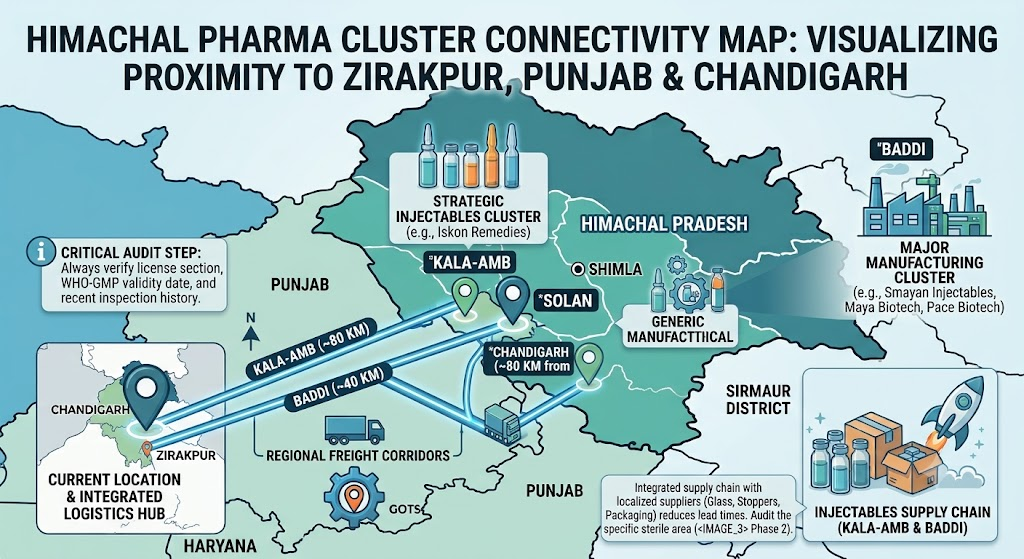
For a buyer, the practical point is simple. A dense cluster means more choice, easier plant visits (several of these sites are within a short drive of Chandigarh), and real competition on price and service.
What Revised Schedule M means for buyers in 2026
Takeaway: Revised Schedule M is India’s updated GMP standard, and from 1 January 2026 all licensed pharmaceutical units are expected to comply with it.
The Ministry of Health and Family Welfare notified Revised Schedule M on 28 December 2023. It moves Indian GMP away from a checklist approach toward a system-based one that aligns with WHO GMP, with requirements covering a pharmaceutical quality system, quality risk management, validation and data integrity. Large manufacturers (turnover above Rs 250 crore) had to comply first. Smaller units that applied through Form A received an extension to 31 December 2025, which is why 2026 is the first year the same rules apply to everyone, as reported by Business Standard.
For an injectable buyer, this changes the questions you ask. “Do you have WHO-GMP?” is no longer enough on its own. Ask whether the plant has completed its Revised Schedule M gap analysis, whether an inspection has confirmed compliance, and what corrective actions are still open. A manufacturer that answers these plainly is easier to trust than one that changes the subject.
None of the ten companies in this guide should be assumed compliant because they appear here. Ask each one for current documents.
How to check an injectable manufacturer before you sign
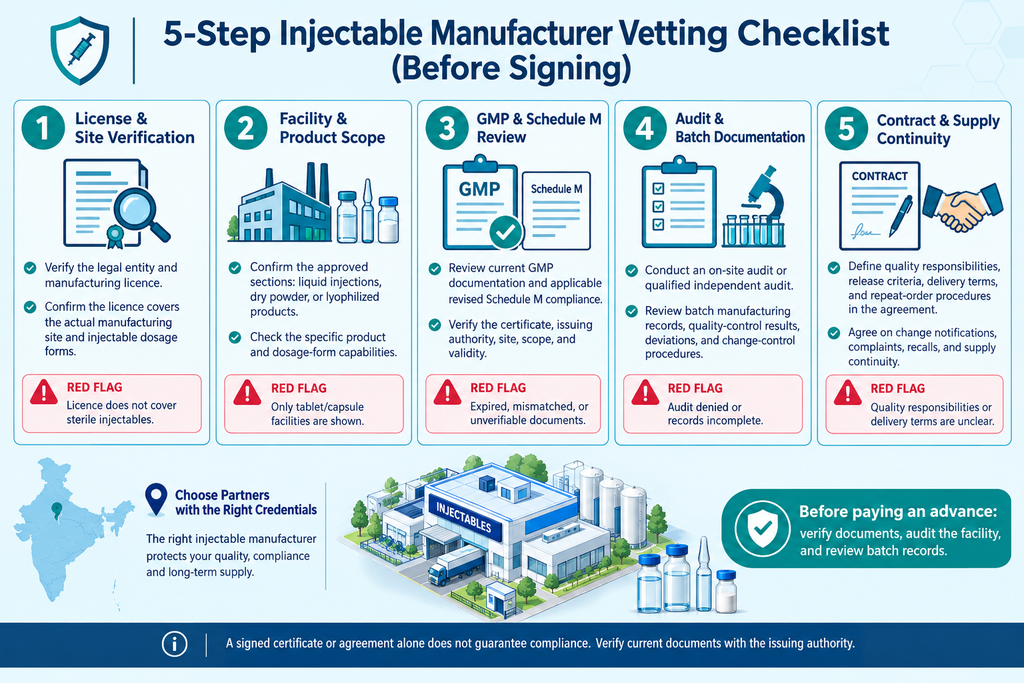
Takeaway: Verify five things before any contract: the manufacturing licence, the WHO-GMP certificate, Revised Schedule M status, sterile process evidence and the quality agreement.
WHO-GMP certificates in India are issued as a Certificate of Pharmaceutical Product (CoPP) through CDSCO and state licensing authorities, and CDSCO publishes a state-wise list of certified units. CDSCO has also announced plans for an online portal that would issue GMP certificates in a uniform format with a barcode for instant verification. Until you can scan a barcode, check the certificate’s validity date and the product categories it covers, and confirm it with the issuing state authority.
| What to ask for | Why it matters | Red flag |
|---|---|---|
| Manufacturing licence covering injectables | The licence must list the dosage form, not just the company | Licence for tablets or syrups only |
| WHO-GMP / CoPP certificate with validity date | Certificates expire and cover specific product categories | No date, expired, or covers different products |
| Revised Schedule M compliance status | Required for all units from 1 January 2026 | Vague answers or “in process” with no timeline |
| Sterile process evidence | Injectables must be sterile and endotoxin-controlled | Refusal to share sterility test, endotoxin or environmental monitoring records |
| Sample batch and certificate of analysis | Lets you test before committing volume | No sample batches offered |
| Quality agreement and defined responsibilities | Decides who pays when a batch fails | Only a price quotation, no written quality terms |
On the sterile side, look at how aseptic filling is controlled. Under ISO 14644-1, ISO Class 5 is the air-cleanliness class that matches the older “Class 100” label, and aseptic filling zones are generally expected to meet it (Grade A in EU GMP Annex 1 terminology). Ask how often the area is monitored, and ask to see media fill (aseptic process simulation) results. If you plan to order cephalosporin or penicillin injectables, ask whether those lines are physically segregated, since Schedule M requires dedicated facilities for them.
Liquid, dry and lyophilised injectables
Takeaway: Liquid injectables are ready to use, dry powder injectables are mixed with a diluent before use, and lyophilised products are freeze-dried for stability.
- Liquid injectables come as vials or ampoules and are administered as supplied. Most firms in this guide make them.
- Dry powder injectables are reconstituted with a diluent just before use. Several antibiotics are supplied this way.
- Lyophilised (freeze-dried) injectables need specialised equipment, so confirm the plant has it before ordering.
Check that the manufacturer makes the specific form you want. Offering “injectables” in general does not mean every form is available.
Mistakes buyers make
Takeaway: Most bad outcomes come from choosing on price alone or accepting a certificate without checking what it covers.
- Picking the lowest quote. Price differences in injectables often reflect real differences in testing and process control.
- Accepting a certificate photo. A photo proves nothing. Ask for the document and confirm it with the issuing authority.
- Ignoring minimum batch size. A cheap rate means little if the minimum batch is far larger than your first-year demand.
- Mixing up WHO-GMP and international approval. WHO-GMP does not mean USFDA or EU approval. If you plan to export, ask which markets the plant is actually approved for.
- Skipping the plant visit. Sterile plants are easy to judge in person. If a manufacturer will not let you visit or arrange an audit, think twice.
Key takeaways
- All ten manufacturers here operate in Himachal Pradesh, most in Baddi.
- Smayan Injectables published this guide, so the table order is not an independent ranking.
- Revised Schedule M applies to all licensed units from 1 January 2026. Ask every manufacturer for its status.
- WHO-GMP alone does not tell you which products are covered. Check the validity date and categories.
- Ask for sample batches, sterility and endotoxin records, and a written quality agreement before signing.
- India’s pharma exports reached US$31.12 billion in FY26, growing 2.16% over FY25, according to IBEF.
FAQs
Which pharmaceutical injection manufacturer is best for a startup?
It depends on batch size, budget and the products you plan to launch. A startup usually benefits from flexible minimum batches, clear pricing and PCD franchise or third-party support. Smayan Injectables lists flexible batch sizes and injectables-only manufacturing, and several others here offer small-order or franchise support, so compare at least three quotes.
What is the difference between liquid and dry injectables?
Liquid injectables are ready to use as supplied. Dry injectables are powders that must be mixed with a diluent first. Most manufacturers on this list make both, but confirm the exact form before ordering.
Do these companies offer third-party manufacturing?
Most list third-party or contract manufacturing in their company information, but offerings differ by firm and by product. Confirm in writing that the specific injectable you want is covered.
How do I check whether an injectable manufacturer is genuine?
Ask for the manufacturing licence, the WHO-GMP certificate with its validity date, and Revised Schedule M status. Confirm them with the issuing state authority and cross-check CDSCO’s published list. Request sample batches and references from past clients.
What is the difference between WHO-GMP and Revised Schedule M?
WHO-GMP is a certification that confirms a plant follows WHO’s GMP standard, issued in India through CDSCO and state authorities. Revised Schedule M is the updated legal GMP standard in India’s Drugs Rules, now applicable to all licensed units. A plant can hold one without having fully met the other, so ask about both.
Why do so many injectable manufacturers sit in Baddi?
Baddi has a large concentration of pharma plants, suppliers and skilled workers. Himachal Pradesh accounts for about 35% of India’s pharma production, per a 2022 statement by a Union minister, with Baddi alone at 20%.
Can I choose a manufacturer that is not on this list?
Yes. This list is a starting point. Apply the same checks (licence, WHO-GMP, Revised Schedule M, sterile process evidence) to any manufacturer you consider.
Author Box
Smayan Injectables. Smayan Injectables is an injectable-focused pharmaceutical manufacturer based in Baddi, Himachal Pradesh, with a corporate office in Chandigarh. Established in 2014, the company lists WHO-GMP and ISO certification and offers third-party and PCD franchise injectable manufacturing. This article reflects the company’s view of injectable manufacturing and supplier selection.
Company website :- https://smayaninjectables.com/
Address: – Smayan Injectables Pvt. Ltd. SCO 50-51, Second Floor, Sector 9 D-Chandigarh, India – 160009
Contact Us :- +91-76967 63030
Email:- archit@smayanhealthcare.com