
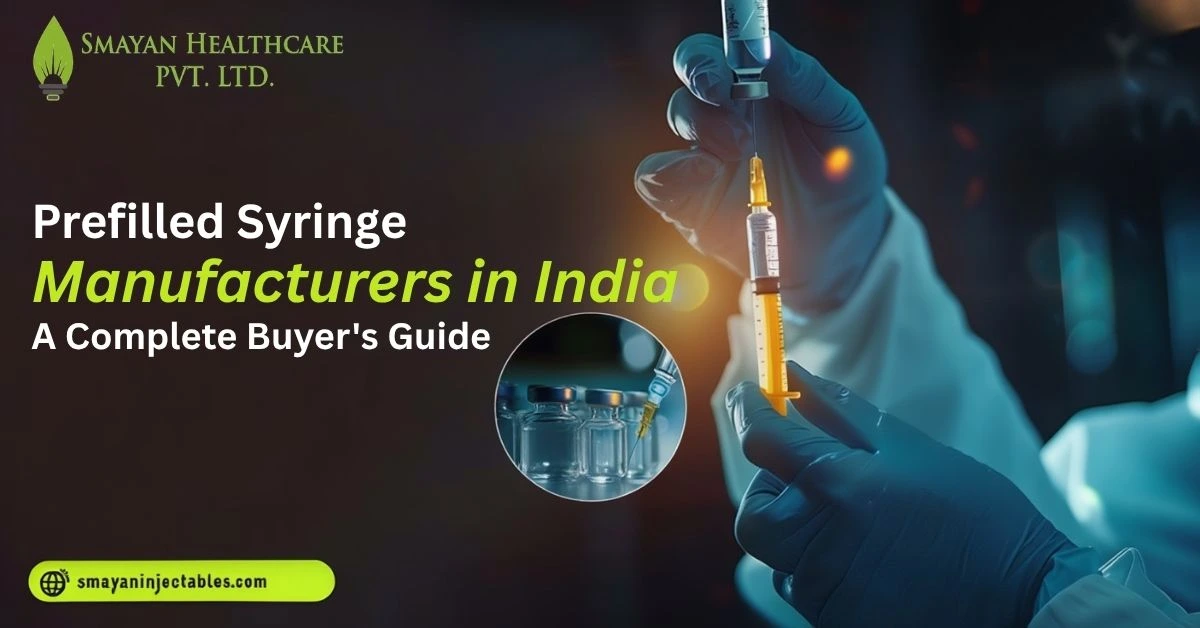
Prefilled syringes have become a standard part of most pharma and PCD franchise portfolios, and for good reason: they cut out the manual dosing step, which can help reduce dosing errors and drug contamination risk compared to drawing medication from a vial. Picking the right manufacturer, though, is where most of the actual risk in this decision sits — the wrong partner can cost you months, not just money.
This guide walks through how to evaluate prefilled syringe (PFS) manufacturers in India, what actually drives pricing, and which of the established names buyers typically shortlist.
What Is a Prefilled Syringe?
A prefilled syringe is a single-use, ready-to-use injection device. Instead of drawing medication from a separate vial or ampoule, it arrives pre-loaded with a measured dose. That’s a real convenience for clinicians, and for patients managing conditions like diabetes or arthritis, it makes self-administration at home realistic in a way vial-and-syringe setups often aren’t.
Prefilled Syringe Manufacturers in India — Quick Comparison
Certification status changes over time. Treat everything below as a starting point for your own due diligence, not a verified fact sheet — confirm current WHO-GMP, export, and product-specific certifications directly with each manufacturer before shortlisting.
| Manufacturer | Location | Material Offered | Certifications | Best Suited For |
|---|---|---|---|---|
| Smayan Injectables | Chandigarh | Glass & polymer | Confirm current certifications directly with the company | Small to mid-sized brands wanting formulation, packaging, and documentation support in one place |
| Akums Drugs and Pharmaceuticals | Multiple plants, Uttarakhand & others | Glass & polymer | Large-scale CDMO; confirm specific product certifications | High-volume, established brands needing full CDMO backing |
| Hindustan Syringes & Medical Devices (HMD) | Faridabad, Haryana | Glass | WHO prequalification reported on select products — verify per product | Exporters targeting UN / global tenders |
| Wellona Pharma | Surat, Gujarat | Glass & polymer | WHO-GMP reported — confirm current validity | Mid-size brands needing injectable specialization |
| Intelico / Intelicure Lifesciences | Baddi, Himachal Pradesh | Glass & polymer | Confirm with manufacturer | Smaller brands wanting low MOQ, faster onboarding |
| Sanjar Pharma | Confirm with manufacturer | Glass & polymer | Confirm with manufacturer | Price-sensitive domestic and export orders |
| Lenus Lifecare | Confirm with manufacturer | Polypropylene & glass | Confirm with manufacturer | Brands wanting both material options under one roof |
| Pace Biotech | Paonta Sahib, Himachal Pradesh | Glass & polymer | Confirm with manufacturer | Brands with a broad injectable molecule portfolio |
Note: Certification status changes over time — always confirm current validity directly with the manufacturer before finalizing a partnership.
This list isn’t ranked, and it isn’t exhaustive. A brand launching its first insulin pen syringe has different priorities than an exporter chasing a CoPP certificate — match the manufacturer to your actual requirement, not to whoever ranks first in a search result.
How MOQ and Pricing Actually Work
There’s no fixed price list for prefilled syringes, and any manufacturer who quotes one without knowing your molecule is guessing. Three things drive the number:
- Batch size. Most manufacturers set a minimum batch — typically 10,000 to 50,000 units per molecule — rather than a minimum unit count. Smaller CDMOs based in Baddi and Himachal Pradesh will sometimes go lower for a brand’s first order.
- Material. Glass is the cheaper starting point because the supply chain is mature. Polymer (COC/COP) runs at a real premium — fewer manufacturers produce it at scale, and the raw material itself costs more.
- Molecule complexity. A standard heparin or vaccine fill is a known quantity to set up. A biologic or cold-chain-sensitive protein isn’t; it needs isolator technology and extra stability testing, and that gets baked into the price.
The honest way to get a real number is to share your molecule, target volume, and material preference with two or three shortlisted manufacturers and compare quotes directly. Anyone offering a fixed rate before that conversation either hasn’t priced it properly or is quoting a generic line, not your formulation.
Manufacturers Buyers Commonly Evaluate
- Smayan Injectables — Chandigarh-based. Works with small and mid-sized brands on formulation, packaging, and documentation support.
- Akums Drugs and Pharmaceuticals Ltd. — One of India’s largest CDMOs, with prefilled syringe capacity built into a much larger third-party manufacturing operation.
- Hindustan Syringes & Medical Devices Ltd. (HMD) — Haryana-based; reported WHO prequalification on select syringe products, and a strong export track record. Confirm current product-level status directly.
- Wellona Pharma — Surat-based, reported WHO-GMP approval, focused specifically on injectable and prefilled syringe lines.
- Intelico Pharmaceuticals / Intelicure Lifesciences — Baddi (Himachal Pradesh)-based; positions itself around contract manufacturing with lower MOQs for smaller brands.
- Sanjar Pharma — Known for competitively priced PFS lines for both domestic and export buyers.
- Lenus Lifecare — Works with both polypropylene and glass-based syringes. Confirm years in operation and current certifications directly with the company.
- Pace Biotech — Third-party prefilled formulation manufacturer with a broad molecule portfolio.
Market Context
Indian prefilled syringe manufacturers are operating in a market that market-research firms estimate at roughly USD 270–360 million currently, with forecasts putting it near USD 500–590 million by 2030–2031 — figures that vary meaningfully depending on which report and methodology you check, so treat them as directional rather than precise. Glass, specifically Type I borosilicate, still holds around 70–72% of the market on the strength of its low reactivity and long track record with biologics, while polymer alternatives like COC/COP are gaining ground for sensitive protein formulations that don’t tolerate glass well.
Diabetes management is generally cited as the largest single application, driven by long-term insulin use, and oncology/biologics is usually flagged as the fastest-growing segment as biosimilar production expands. Vaccines and self-injectable anticoagulants (LMWH) round out the high-volume categories, and home healthcare adoption is pushing more of this volume toward self-administration devices generally. If these numbers matter to a business decision you’re making, pull the underlying report rather than relying on a summary — market estimates for this category shift by report and by year.
What to Look for in a Manufacturer
Regulatory certifications. A serious manufacturer holds a current WHO-GMP certificate and follows Revised Schedule M. Check that certificates are issued in the company’s own name and cover the specific drug or device class you need — a certificate for a different product line doesn’t help you.
Filling and packaging technology. Automated nest and tube filling, isolator technology, and automated visual inspection all reduce human contact with the product, which lowers contamination risk. Ask what’s actually automated versus manual on their line.
Material capability. Look for manufacturers offering both Type I borosilicate glass and newer COC/COP polymer options, since different drug chemistries need different containers.
End-to-end support. A strong partner offers formulation support, stability testing, primary packaging, and regulatory documentation together, rather than making you coordinate separate vendors for each.
In-house quality testing. Manufacturers with an in-house lab for sterility and packaging-integrity testing generally move faster than ones that outsource every test — outsourcing adds turnaround time you’ll feel at launch.
Types of Manufacturers by Focus
- Generic injectable lines — manufacturers focused on high-volume, steady-demand molecules like blood thinners and vaccines, using proven formulas. Usually the faster route.
- Custom and specialty work — manufacturers who take on newer or less common doses. Expect more time and more paperwork, but it’s often the only path to a genuinely differentiated product.
- Export-ready manufacturing — if you’re selling abroad, look specifically for a CoPP certificate and prior experience with your target country’s regulatory requirements. Not every domestic manufacturer offers this — ask directly.
Glass vs. Polymer: Which One Do You Need?
This decision affects shelf life, drug compatibility, and cost — it’s usually the first real fork in the road.
| Glass (Type I Borosilicate) | Polymer (COC/COP) | |
|---|---|---|
| Market share | ~70–72% | Smaller, growing fast |
| Best suited for | Biologics, sensitive proteins, most standard injectables | Protein formulations prone to glass-related issues |
| Key advantage | Low reactivity, decades of proven compatibility | Break-resistant, lighter, avoids glass delamination |
| Key drawback | Can shed silicone or particulates with some formulations | Costs more; fewer manufacturers run it at scale |
| Typical use case | Vaccines, heparin, most generic injectables | Newer biologics where glass interaction is a documented risk |
Note: The right material depends on your specific formulation’s stability profile — confirm with your manufacturer before finalizing.
Configuration Details That Matter Beyond Material
Glass vs. polymer isn’t the only decision. Three other choices shape which syringe actually fits your drug:
- Needle system — staked needle (fixed permanently) or Luer lock/cone (attached separately before use). Staked is simpler for the end user; Luer gives flexibility if needle gauge needs to vary by market.
- Chamber — single-chamber works for drugs already in liquid form. Dual-chamber is for anything needing reconstitution, keeping powder and diluent separate until the moment of injection.
- Format — bulk syringes ship unsterilized for someone else’s fill line. Ready-to-fill (RTF) syringes come pre-sterilized and nested in tubs, so a manufacturer can load them straight into a fill-finish operation without an extra sterilization step.
Which combination you need comes down to your drug’s stability profile and how it’ll be administered. That’s worth a direct conversation with your shortlisted manufacturer, not a guess from a spec sheet.
Fill-Finish vs. Empty Syringe Supply — Know Which One You’re Buying
This is where a lot of buyers get tripped up. Some manufacturers only supply the empty syringe component — sterilized barrel, ready for someone else to fill. Others run the full sterile fill-finish operation and hand you back a finished, drug-loaded syringe ready to label and ship.
Confuse the two and you lose weeks: a brand expecting a finished product ends up with empty barrels and no fill-finish line to use them on, or a fill-finish CDMO sits waiting on syringe components that were never part of the deal. Ask this question first, before anything else, when shortlisting.
Certifications Beyond WHO-GMP
WHO-GMP is the baseline, not the full picture. Depending on your target market, also ask about:
- ISO 15378 — covers primary packaging materials specifically, more directly relevant to syringe barrels than a general manufacturing certificate.
- ISO 13485 — the quality management standard for medical devices. Whether a specific prefilled syringe is regulated as a drug, a device, or a combination product depends on the product and the jurisdiction you’re selling into, so check this against your actual regulatory pathway rather than assuming it applies uniformly.
- DMF (Drug Master File) — relevant mainly for exports to markets like the US or EU, where a manufacturer holding a DMF for their syringe components has already filed technical data with the relevant regulator, which can save time during your own registration. Requirements differ by country, so confirm what your specific target market actually requires.
If a manufacturer can only point to WHO-GMP, that’s not automatically disqualifying — but it’s worth asking why, particularly for export-bound orders.
Before You Sign: A Due-Diligence Checklist
- Get a real answer on lead times for your specific molecule — not a generic “2–3 weeks.”
- Ask for a cleanroom audit: virtual at minimum, in-person if the order size justifies it.
- Request extractables and leachables data if you’re filling a biologic or protein-based drug.
- Compare total cost of ownership, not just per-unit price. A cheaper quote that leads to a failed batch or a delayed launch ends up costing more than whatever it saved.
Smayan Injectables
Smayan Injectables is a Chandigarh-based prefilled syringe manufacturer working with small and mid-sized pharma brands on formulation support, packaging, and regulatory documentation. If reliability and flexibility for a smaller-volume launch matter more to you than sheer CDMO scale, it’s worth a call: +91 7696763030.
Smayan Injectables holds WHO-GMP certification for its Chandigarh facility and runs in-house sterility and packaging-integrity testing, so batches don’t sit waiting on an outsourced lab before they can ship. The team works directly with small and mid-sized brands on formulation, primary packaging, and the regulatory paperwork that usually eats the first few weeks of a launch — most first-time buyers underestimate exactly how much of that timeline is paperwork, not production. MOQ starts lower than most large CDMOs will quote, which matters if this is your first prefilled syringe order and you don’t want to commit to 50,000 units before you’ve tested the market. Call +91 7696763030 with your molecule and target volume, and you’ll get a quote against your actual formulation — not a generic price list.
Final Thoughts
The Indian prefilled syringe market keeps expanding, and manufacturers are under real pressure to hold quality steady as order sizes grow. Whichever partner you choose will set the pace for your entire launch — so verify certifications yourself, get quotes based on your actual molecule, and don’t skip the due-diligence checklist just because a manufacturer looks good on paper.
FAQs
Q1. What’s the difference between a prefilled syringe and a vial?
Ans. A prefilled syringe is ready to use with no mixing step, which reduces the chance of dosing errors — especially useful in high-volume clinical settings.
Q2. Why does WHO-GMP certification matter?
Ans. It’s evidence that a manufacturer follows international drug manufacturing standards. It’s the first thing to check, though not the only thing.
Q3. How do I know if a manufacturer can actually export?
Ans. Ask for their CoPP certificate and evidence of experience with your specific target country’s regulatory requirements.
Q4. What’s a typical lead time for an order?
Ans. It varies by manufacturer and by molecule — there’s no universal number, so get a specific answer from your shortlisted partner.
Q5. Can I get a custom formulation in a prefilled syringe?
Ans. Yes, but expect a longer timeline and more paperwork than a standard, already-proven molecule.

Reviewed by: Quality Assurance Lead at Smayan Injectables, with extensive experience in injectable manufacturing, quality assurance, and regulatory documentation.